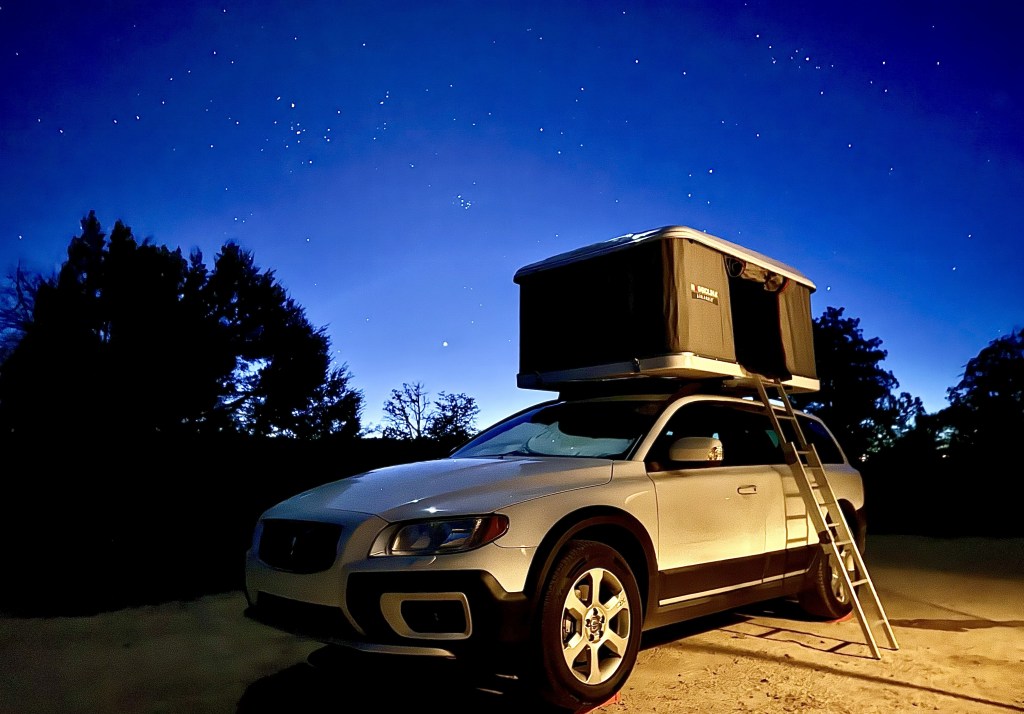
Two years ago, overlanding was at its peak in the United States. It seemed like everyone was buying offroad vehicles and covering them with lights, rooftop tents, and plastic fuel canisters.
My decision to buy a rooftop tent felt like I was “jumping on the bandwagon.” So, what’s it been like to own? Would I buy another?
My Camping Reality
We started to camp more often post-pandemic because we wanted to see more of the outdoors. However, to be honest, we didn’t enjoy tent camping. I never slept well. Between wind noise and constantly rolling off my inflatable sleeping pad, my sleep was interrupted every hour.
Three days into a week-long Colorado mountain adventure, we pulled the plug on our tent camping plans and booked hotels. I liked to envision myself as a rugged outdoorsy person, but the reality is I like some comfort. I’m not too proud to admit it.
Once we got home, we started to consider a teardrop trailer.
Researching Trailers
Buying a truck does not align with our current financial goals, so the trailer would need to be towable by our 2009 Volvo XC70. My criteria were that it needed to be somewhat affordable and offer basic shelter. I was looking for something that was easy to set up and provided a comfortable bed.
The Timberleaf Pika kept moving to the top of my list (Timberleaf Trailers Official Website: The Pika). After months of deliberation, we were about to place an order for one. The trailer would have been nearly $20,000 with an estimated six-month wait time. Pricey, but still a fraction of the cost and weight of an Airsteam trailer.
However, I had ongoing doubts about buying a trailer.
First, I didn’t want to store a trailer. We have a two-car garage which houses both of our vehicles. Neither car lives outside. My option with a trailer would be to either park a car outside or pay thousands of dollars in RV storage per year.
Second, I had doubts about my vehicle. Our Volvo is sixteen years old with a naturally aspirated six-cylinder engine and no towing package. Living in the American West, our road trips have thousands of feet of elevation change in extreme temperatures. I didn’t know how the vehicle would do on either uphill or downhill segments with a 1,500-pound trailer.
These concerns were too big to ignore.
A New Option
During this trailer research, I realized that a high-end rooftop tent could offer the basic shelter that I needed for a fraction of the cost of a trailer. This is when I found Autohome.
Autohome is an Italian rooftop tent manufacturer. Founded in 1958, they offer hardshell tents in either fiberglass or carbon fiber. Depending on the tent, the structure is raised with either gas struts or, like ours, a hand crank.
The tents, which are constructed in Italy, use canvas like safari tents. This makes them quiet in the wind. The tent roof is also lined with sound-deadening fabric for rain. There are storage pockets throughout the inside of the tent and a built-in LED light provides illumination. A mattress is also included inside the tent, although it is exceptionally firm.
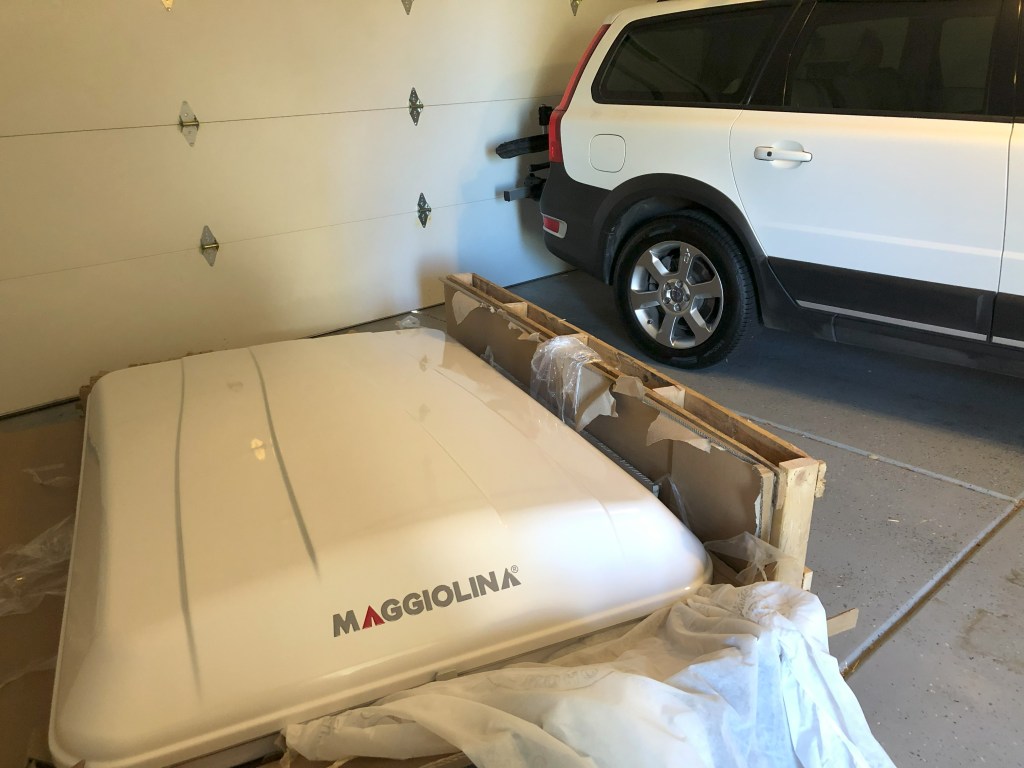
Our medium sized Airlander Plus tent cost $4,299 in 2023. Certainly not cheap, but far cheaper than a $20,000 trailer. I also paid $400 for the tent to be shipped from the Pacific Northwest to Phoenix.
Our Experience with the Autohome Tent
Our Airlander Plus has shown a few major benefits. The tent is fully constructed in about 3 minutes. The hardshell construction only costs us about 2 miles per gallon on the highway and it is exceptionally quiet at speed. None of our interior cargo capacity is lost to a large tent and, on our Volvo XC70, the vehicle still fits into any garage.
One of the best features is that the white fiberglass does not absorb heat as easily. It’s fascinating. Even in direct sunlight, the tent’s shell is not hot to touch. This helps keep the tent’s temperature more comfortable.
At camp, the canvas construction is silent, even in gusty wind, and it provides better insulation than a standard tent. I’ve had excellent nights of sleep in it. The elevated position also provides peace of mind against critters, like snakes.
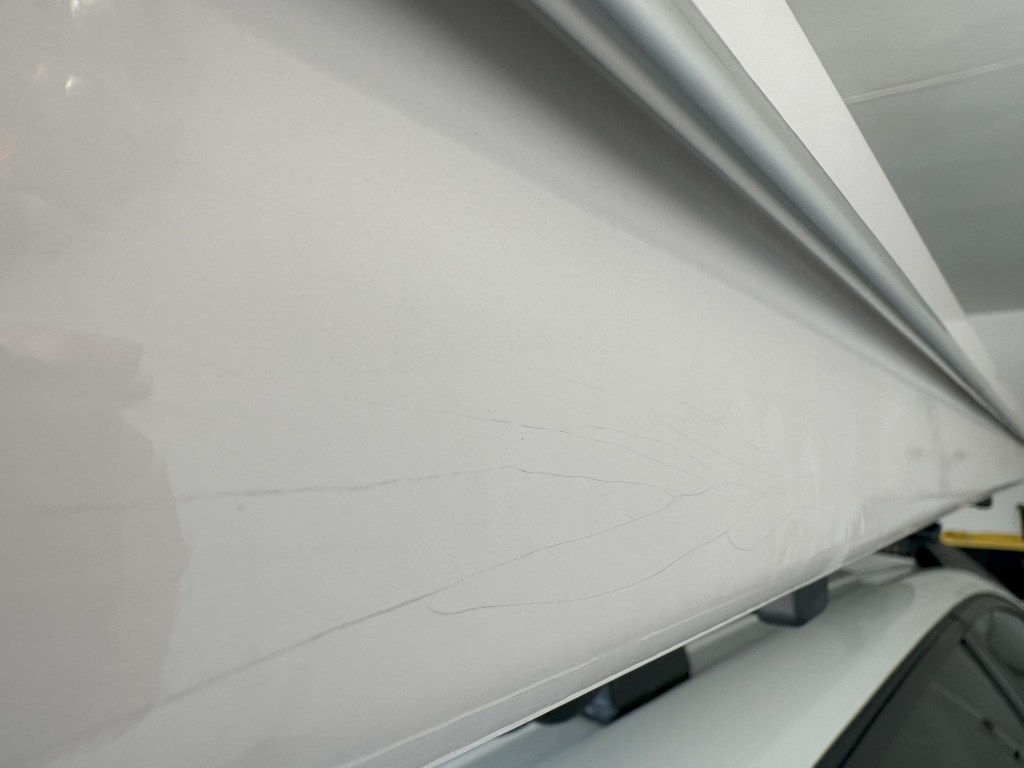
However, nothing in this world is perfect. That includes this tent. Our most significant issue has been slight cracking in the fiberglass. I reached out to the retailer that sold us the tent, which helped us start a warranty claim.
Autohome found that the cracking was only cosmetic. They suggested that the tent may have been installed too far back on the vehicle. As a result, I moved the rails a few more inches to provide the best possible weight distribution.
I can’t adjust the tent any further because then it will either block the rear hatch from opening or be too close to a joint in the roof rail.
The cosmetic cracking hasn’t affected our ability to use the tent, but it’s a disappointment on a two-year-old $4000 purchase. My research online has uncovered multiple discussion posts from other owners with this observation.
My other main complaint about the tent is the mattress. We started using our inflatable camping pads on top of it inside the tent. It’s that firm.
Would I Buy Another Rooftop Tent?
Our overall experience with the Autohome Maggiolina has been good. Despite the issues noted above, the tent’s construction has provided many benefits.
However, I would not personally buy another rooftop tent.
I sometimes get tired of the tent always being on top of the Volvo. Any rooftop tent is heavy and cumbersome to remove. It’s not worth the trouble.
The weight of the tent also limits future vehicle options. If anything happens to the Volvo, I’d need to get another vehicle which can support the weight/size of it. Any of those vehicles are not cheap.
My travel priorities are also changing. I’d rather spend money on flights, hotels, and bicycle rentals than camping gear or car expenses.


Leave a comment