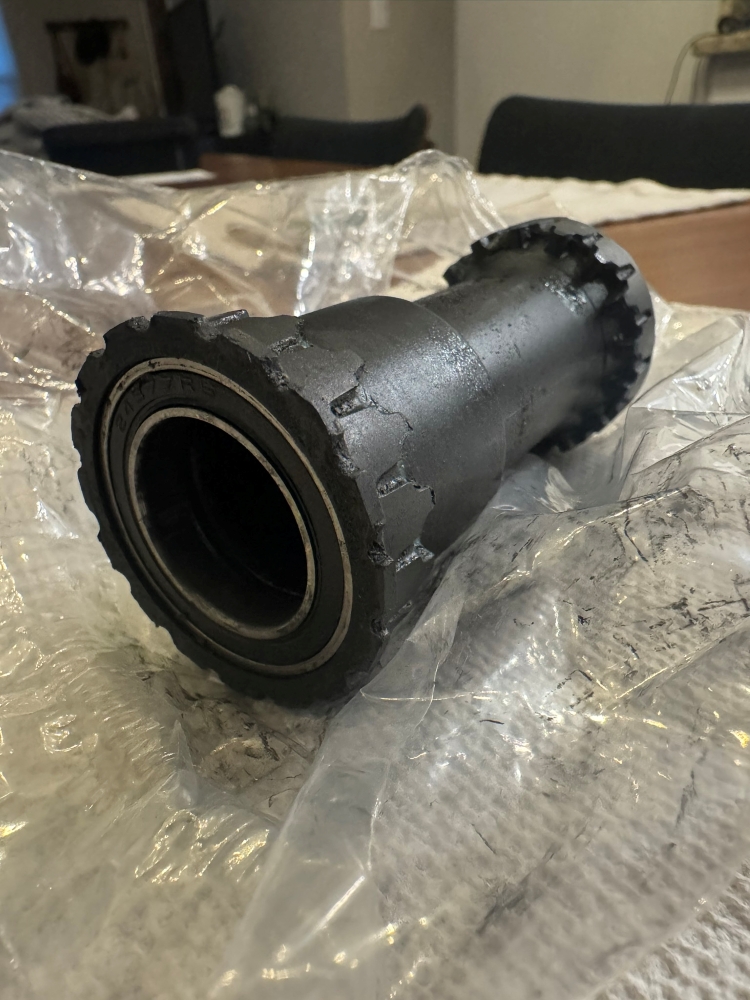
Owning multiple bicycles means ongoing maintenance. I’d just finished putting the Fuji back together, so every bike was running smoothly again. Everything seemed to be dialed in.
Well, for a short time at least. It’s been another rough week at the office, so I signed off, grabbed the Canyon, and headed out for a road ride.
I hadn’t gone far when I started hearing a weird creaking sound. It felt like a front-end creak—like it was coming from the fork or wheel.
Was it something stuck to the tire? No. A little tag still tucked around the inside of the brake rotor? No. Maybe the rotor itself? Still no.
Troubleshooting on the ride: quick checks and a safety call
About four miles in, I stopped at a repair stand along the Country Club Way pathway. I popped the bike up on the stand and started with the front end.
I didn’t see any cracking or obvious damage on the fork. The wheel looked fine too. There were no loose spokes, no wobble. Nothing jumped out. After a bit of troubleshooting, I decided there was too much risk to keep riding.
My brain immediately jumped to the worst-case scenario: a compromised carbon fork (or something loose in the front end).
Until I could rule that out, I had to assume the bike was unsafe. With carbon fiber, damage can be hard to spot—and if something is compromised, it can fail suddenly. A fork failure is about as bad as it gets: the whole front end could lose structure at speed. Too much risk.
So, I turned around, met up with my wife (she was leaving the gym on her eBike), and we cautiously headed home.
At-home inspection: carbon fork check (including a coin tap test)
Once home, my repair stand went up in the living room and I inspected more carefully. I cleaned the fork, then gently did the “coin tap” test to listen for any dead/irregular spots. I also used a bright headlamp to look for cracks.
Nothing.
Next, I tightened and checked the headset and stem. I might’ve gotten a tiny adjustment out of the top cap, but nothing stood out.
Diagnosis: crank drag and the bottom bracket
Finally, I spun the cranks while the bike was on the stand. It felt weirdly difficult to pedal—classic crank drag, like a bearing was binding somewhere.
Was it in the wrong gear? No. Was the derailleur out of adjustment and the chain catching? Also no.
I removed the chain completely and tried again. Still tough to turn.
Ah! The bottom bracket!
It turns out the bottom bracket failed, so the crank wasn’t rotating smoothly. In hindsight, the bottom bracket creak was probably there the whole time—it just echoed in a way that made it sound like it was coming from the fork.
Fix: replacing the bottom bracket
I’m cautiously optimistic. For now, the bike is still on the stand while I wait for parts. The original bottom bracket is a Ninja Lite with a plastic housing. It probably saves a little weight, but I’m replacing it with something metal.
The replacement is an Enduro Bearings TorqTite. I opted for stainless bearings since I live in a desert. Ceramic was tempting, but I plan to eventually upgrade from the Canyon to something titanium, so there was no reason to pay for the absolute best here. There’s rarely wet weather to deal with and this should be a big improvement either way. It also makes me wonder how long I’ve been pedaling against real drag without realizing it.
If a road bike creak seems like it’s coming from the front, don’t stop there—isolating the drivetrain (even just removing the chain) can quickly confirm whether the noise is actually coming from the bottom bracket.
 Pistons Then Pedals
Leave a comment