A few years ago, I was bicycling in Gilbert along the Western Canal. It was a beautiful April morning, and I was headed to meet a friend. The month had been full of bicycling, and I was feeling confident in my skills.
As I neared his home, there was a section of pathway which transitions from gravel to concrete. The junction between the two surfaces had a curved profile. It went from a simple crushed gravel path to a concrete sidewalk which meandered to look more pleasant.
I slowed down for the change in surface and prepared for the bump. Knowing a risk existed, I angled my front wheel to meet the concrete bump as close to a 90° angle as possible.
My technique was wrong. I didn’t know it, but the gravel was deeper just before where the two surfaces met.
The bicycle’s front tire sank into the gravel. I decelerated more as the front tire twisted in the loose earth.
After the Crash: Assessing My Injuries
The next second was a blur. Before I could react, I felt the front end of the bike slip out from beneath me. I hit the concrete surface hard.
Stunned, I realized what had just happened. I picked myself up off the ground and tried to regain my composure. I reached up and realized that blood was gushing from my eyebrow. My sunglasses were in pieces across the pavement. The arm of my sunglasses had broken and driven into my face upon impact. I was fortunate that it had not gone into my eye itself.
My Garmin cycling computer beeped angrily for 30 seconds before notifying my family. The device’s incident detection system had sensed the hard impact. Now, it was texting my wife and parents.
Over the next few minutes, as I informed them that I was injured but mobile, I assessed my injuries. My helmet had taken a huge hit just above the sunglasses. It cracked just above my temple. Road rash was everywhere across my right side. Most importantly, my thumb hurt. Badly.
I tried to move it, but it just didn’t feel right. A doctor confirmed I had broken it a couple hours later.
The injury to my thumb would require two surgeries, five surgical pins, physical therapy, and three months to recover. The incident was a major reminder that bicycling carries inherent risk. It’s also why I will never consider bicycling without a helmet.
Navigating Construction Zones as a Bicyclist
Earlier this week, I was bicycling in Chandler. My destination was the library, and I was riding my legal eBike (not an electric motorcycle).
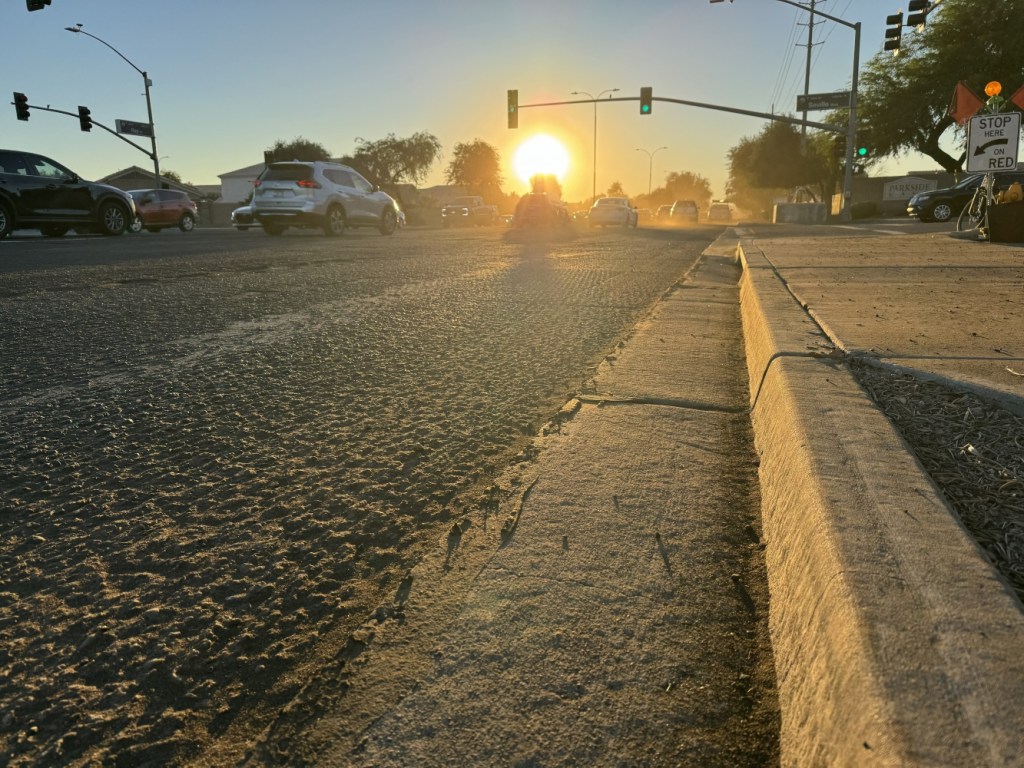
Heading westbound on Ray Road, I saw a lot of smoke or dust in the air past the freeway onramp. I thought it was a car fire at first.
As I was nearing the area, I saw signs about road work. I realized that the dust in the air was a result of recently stripped-away asphalt. It looked like work had just ended for the day.
I was riding in the bicycle lane which is made of concrete through the intersection. The concrete was intact, but there was a big, raised edge where it met the parallel road surface.
After a short distance, the concrete ended, and the bike lane dropped down onto the stripped asphalt. The roadway was degraded, but it was still navigable. I hit the bump from concrete to asphalt without issue.
My issue appeared at the upcoming intersection. I needed to turn right, and I could tell that another large edge existed. Cars buzzed past me on my left. The dusty air added to the sensory overload.
I braked and, remembering my past injury, prepared for the transition. Ray Road is a busy thoroughfare. I didn’t have enough space to move to the left to approach from a 90-degree angle. It wasn’t going to be perfect, but I thought I had it.
I didn’t.
The edge was larger than I expected. Just like my earlier injury, the front tire washed out from beneath me and I hit the deck.
I was travelling slower and my chunky eBike took most of the hit. The grip on my handlebar absorbed most of the impact, but I had some slight road rash on my shoulder. Otherwise, I was surprisingly okay. I’m still shocked at how little injury I sustained this time.
This was my reminder that junctions between surface types are incredibly dangerous. In my opinion, they are one of the most underrated hazards in cycling.
I’m reminded that, if in doubt, stop. Take the time to assess. It’s not worth the risk.
 Pistons Then Pedals
Leave a comment