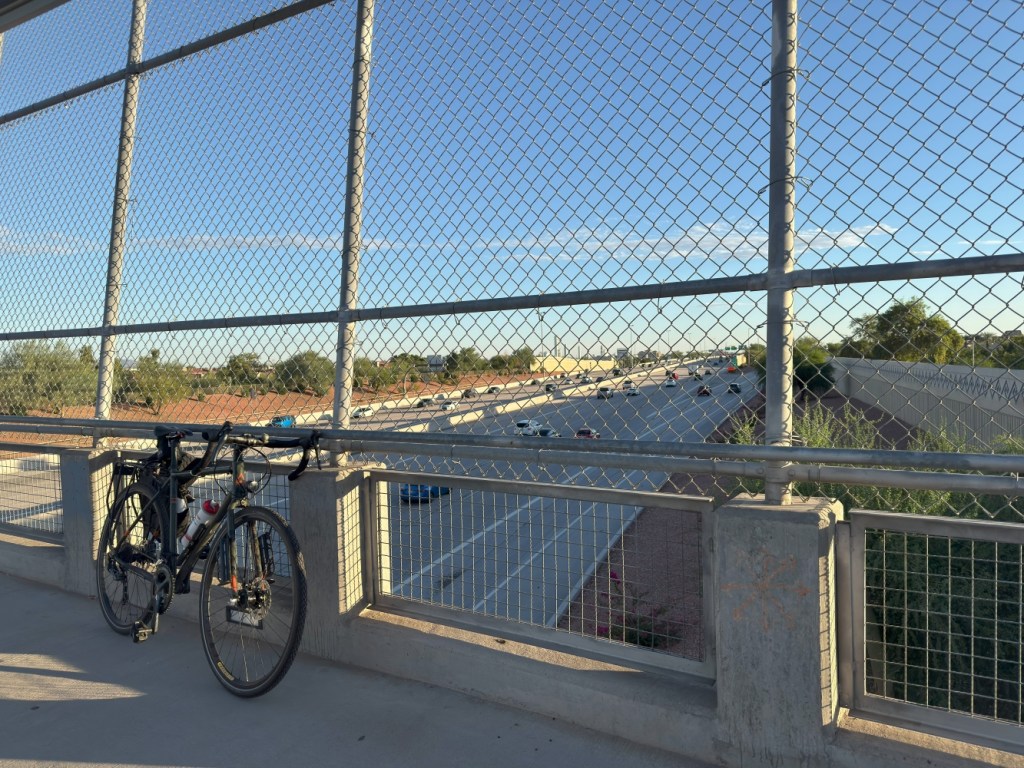
The online world presents a clear stereotype of Phoenix. An endless strip mall consisting solely of big box stores. Vast roads baking in perpetual 115-degree heat. Pedestrians fighting for survival in a quasi-Mad Max hellscape where cars are given unchecked freedom.
Is this reality? Are all parts of Phoenix the same?
Not necessarily.
For those seeking bikeable routes which connect to light rail or major attractions, the East Valley provides some strong options now.
There is certainly room for improvement and other parts of the metropolitan area lack basic infrastructure for bicyclists and pedestrians. However, I believe it’s important to show the nuance of bicycling here.
Big box stores are plentiful and you will be bicycling around automobiles, but bicycle infrastructure does exist in some regions of the valley.
On my bike ride yesterday, I took the time to document a few specific, but simple, amenities which are contributing to making my bicycle network better.
This infrastructure helps bicyclists avoid arterial streets. It also provides economic benefit through property value increases and tourism, decreases public health care expenses through better health, and reinforces individual freedom by allowing residents to use multiple forms of transportation. Here in Phoenix, most bicyclists are also motorists.
Galveston Street Bicycle & Pedestrian Bridge
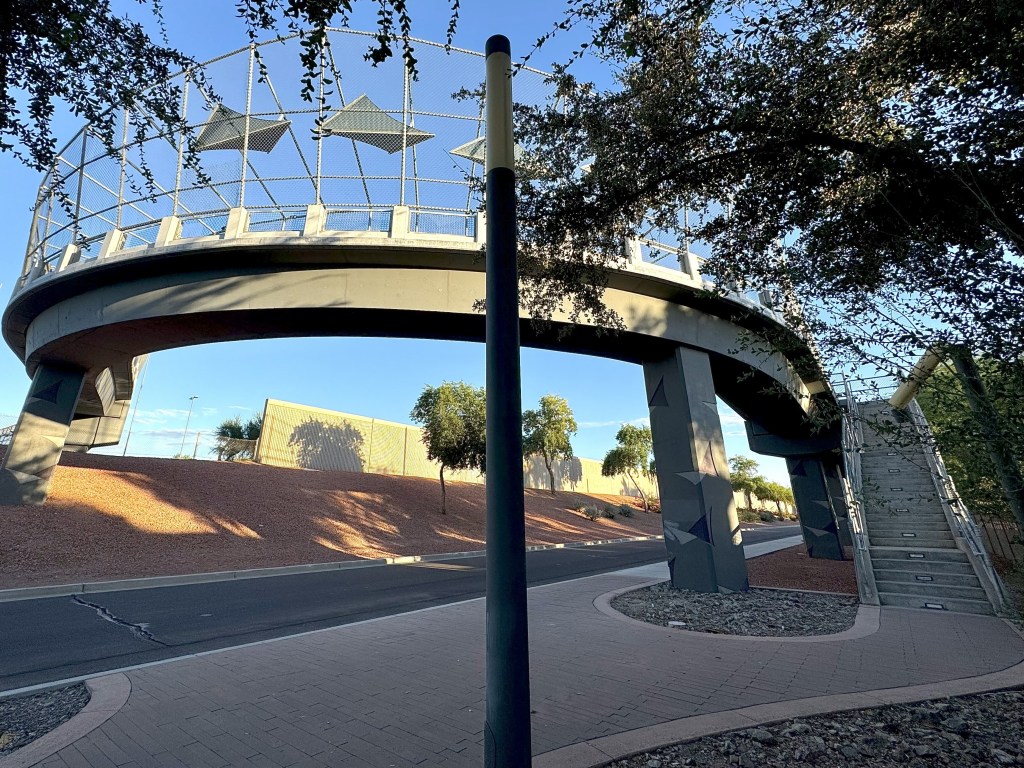
One of the best examples of bicycle infrastructure in my immediate area is the Galveston Street Bicycle & Pedestrian Bridge. It’s not new as the simple bridge was built in 2014. It passes over Loop 101 and provides pedestrians and cyclists with a safe alternative to either Chandler Road or Ray Road. These two arterials also offer simple painted bike lanes, which I use, when necessary, but the pedestrian bridge is the best choice by far.
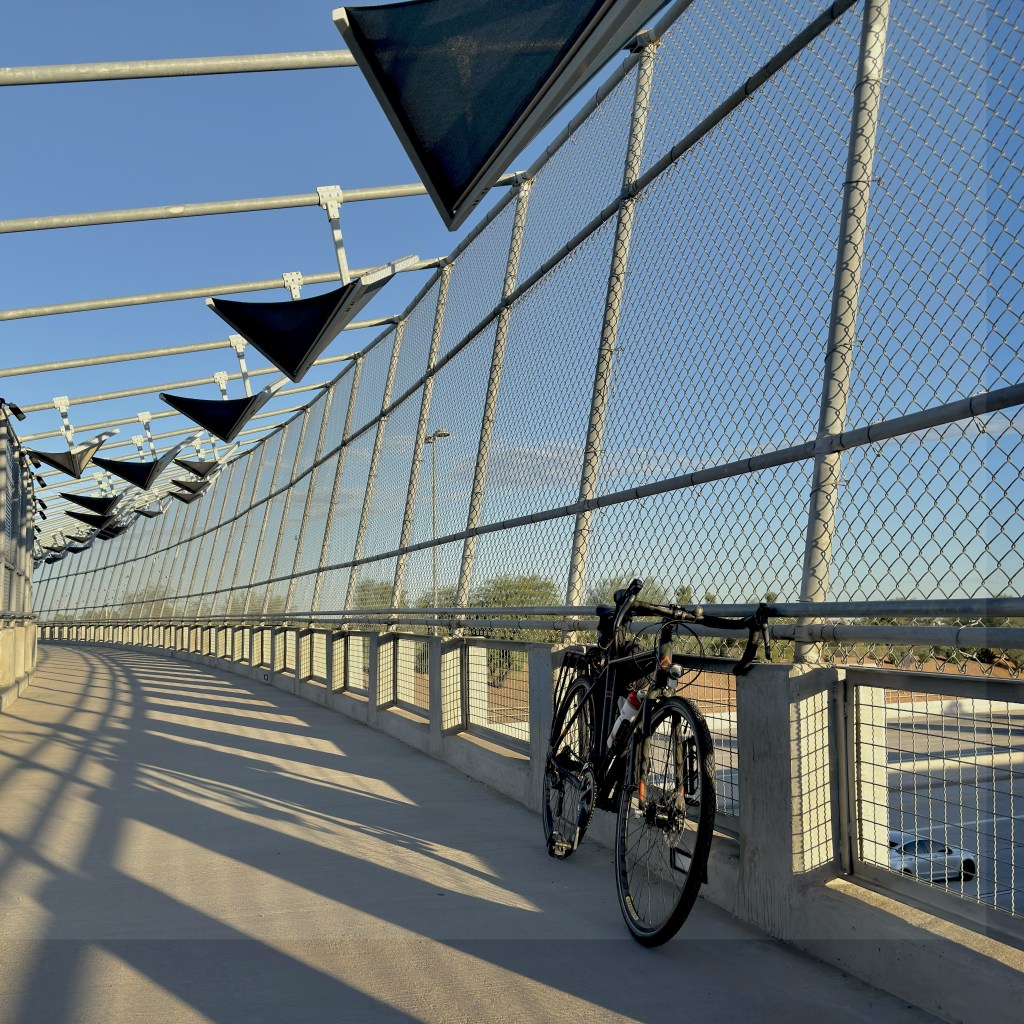
According to the Arizona Department of Transportation, the bridge has a total length of 1,145 linear foot and, between structural and reinforcing steel, uses a total of 574,000 pounds of steel. Planners also saved taxpayer money by installing the bridge’s center pier 4 years earlier while making improvements to Loop 101 (ADOT Website – New bicycle/pedestrian bridge is open in Chander. Posted 2/14/2014). The bridge was designed by T.Y. Lin (TY Lin Official Website – T.Y. Lin International Announces Completion of Galveston Street Bicycle & Pedestrian Bridge in Chandler, Arizona).
The bridge provides connectivity to the Galveston Bicycle Route, as well as various parks. A bicyclist can use it to access the city-owned RC airplane airfield at Thude Park, Arrowhead Pool, and three miles further, downtown Chandler. Retail options like Chandler Fashion Center, Whole Foods, or the ever-popular Hash Kitchen brunch spot are also accessible not far from the route.
A Simple Traffic Signal Can Unlock New Bicycle Routes
Nearby, the city of Tempe, which is home to Arizona State University’s main campus, has been prioritizing connectivity. Recent smaller projects, which easily go unnoticed by most, provide safer routes for cyclists. These improvements have allowed me to avoid arterial streets altogether in many cases.
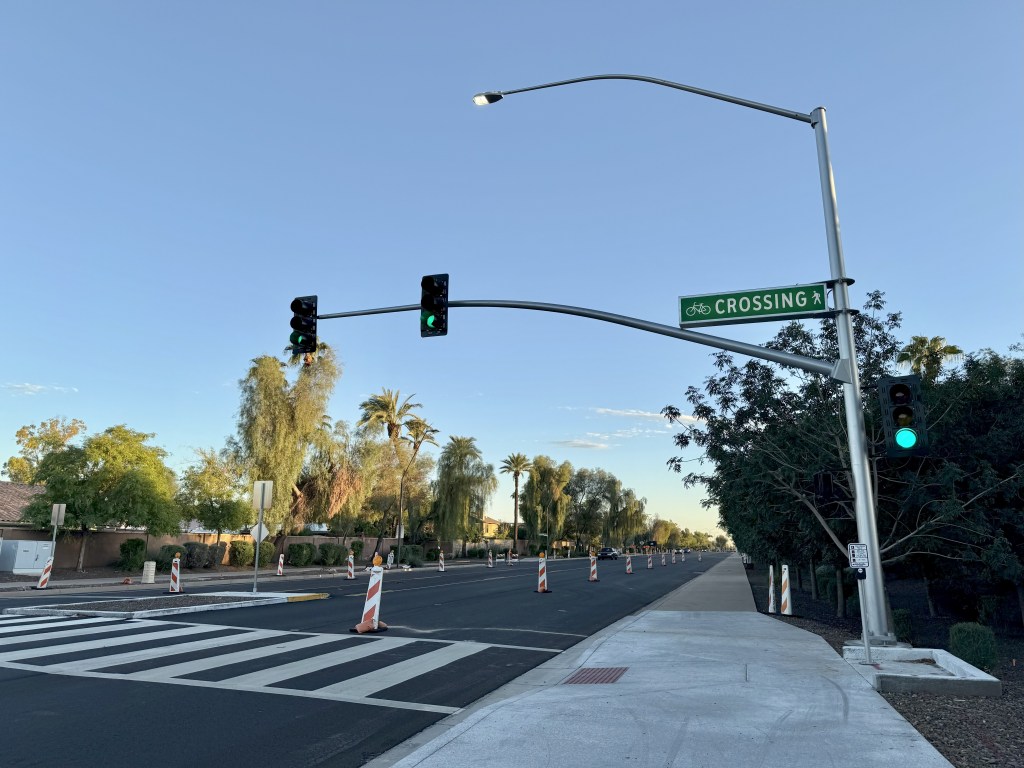
A relevant example of this today is the new pedestrian crossing on McClintock Drive, south of Warner Road. The simple traffic light turns red when a bicyclist or pedestrian arrives and pushes the button. Commendably, the light turns red at once.
This new traffic signal allows a better way to get from Chandler to the new Country Club Way pathway and the Western Canal. There previously was not a safe way to cross McClintock during peak travel times, except on Warner. Now, Warner can be bypassed altogether, and you can ride through quiet residential neighborhoods.
Necessary Regulation for eBikes
Finally, another modest example of needed infrastructure, which appeared this week, is a simple sign. As I’ve discussed in other posts, I often use an eBike.
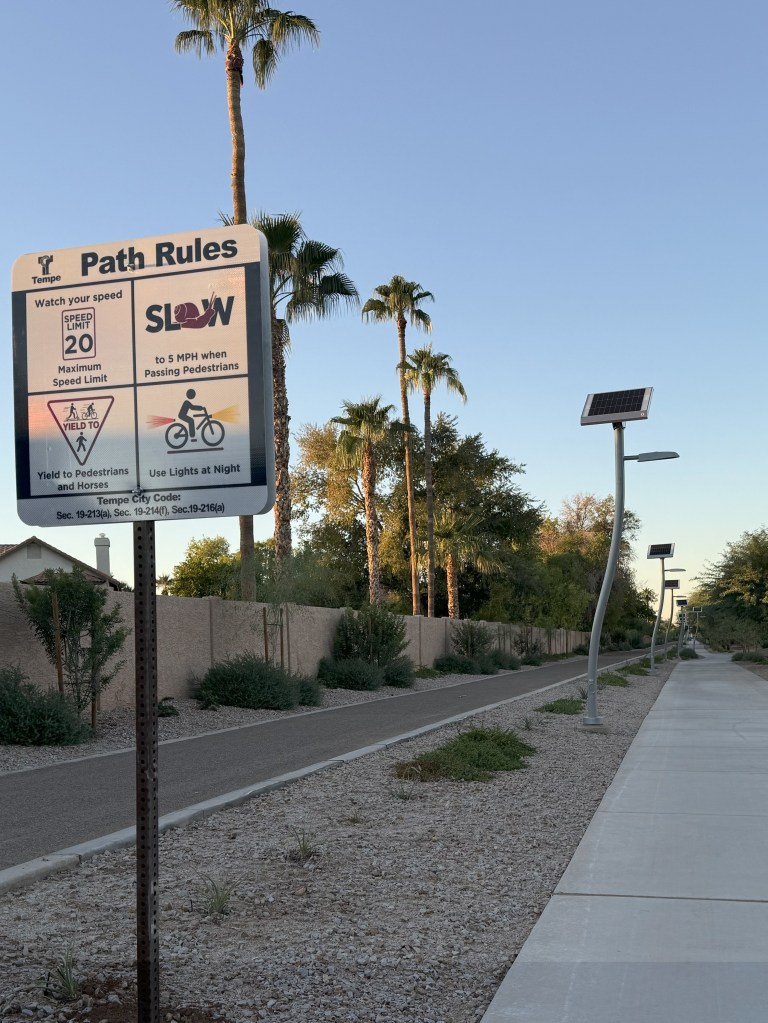
I’m concerned about the perception of eBikes. There are many manufacturers selling electric motorcycles and branding them as eBikes. These potentially dangerous vehicles, which are not eBikes and never have been, don’t meet any of the criteria for Class 1, Class 2, or Class 3 eBikes. Many tend to be ridden by reckless teenagers (which raises the question of parental responsibility, but that’s a separate topic).
I’m truthfully happy to see the city posting clear speed limits and rules. I want my pathway access to be fair for equestrians, bicyclists, and pedestrians alike. As a responsible cyclist (and eCyclist), I’m happy to follow simple rules which allow everyone to enjoy this public infrastructure.
If you’re interested to learn more about the Country Club Way Pathway, check out my recent article here: https://pistonsthenpedals.com/2025/06/04/countryclubpathway/
 Pistons Then Pedals
Leave a comment