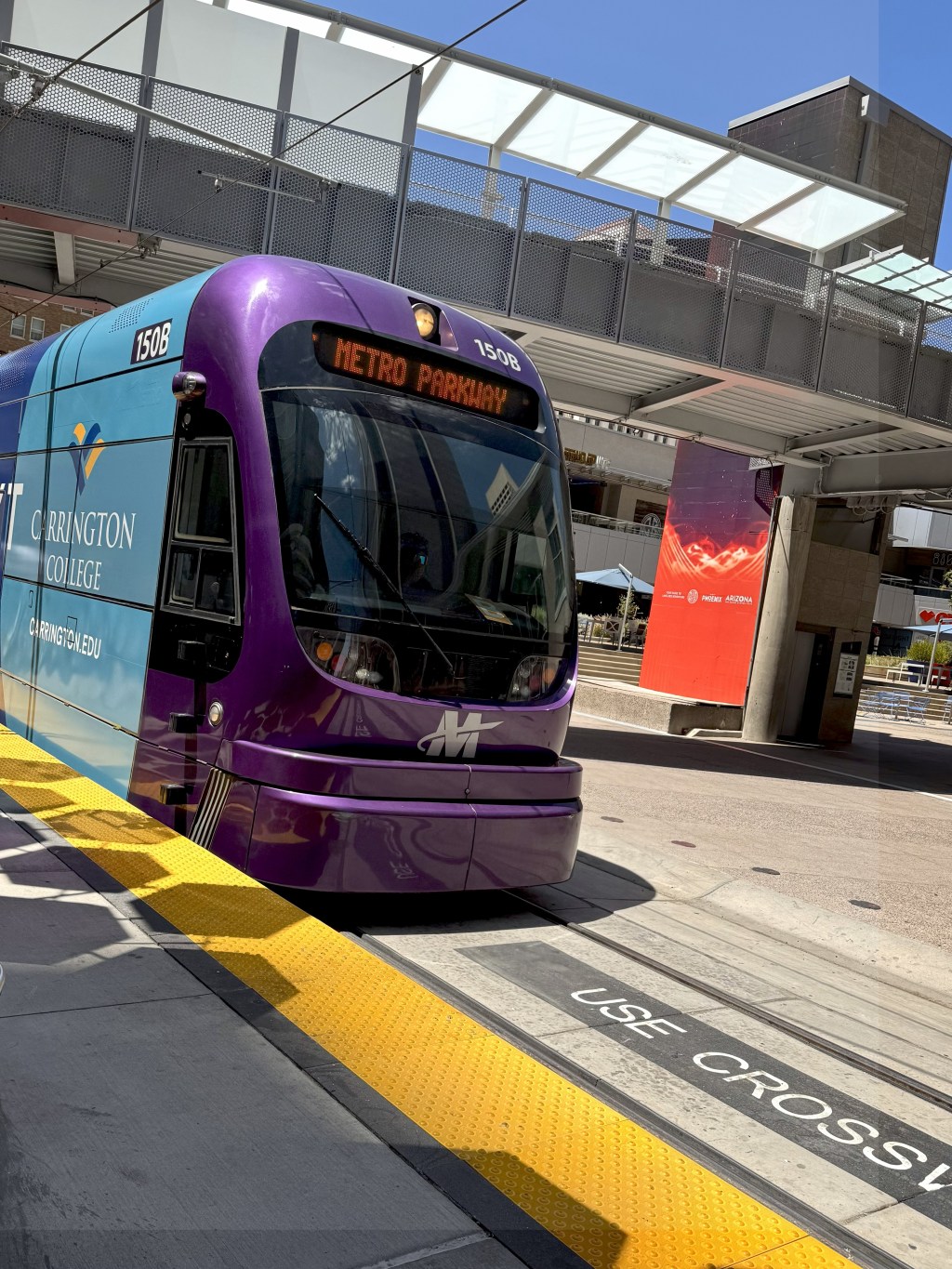
Phoenix is a notoriously car-dependent city. The Phoenix metropolitan area covers nearly 15,000 square miles. For comparison, the state of Connecticut is approximately 5,500 square miles.
Most people here need a car.
However, there are a few denser sections of the valley which have benefitted from light rail investment over the past twenty years.
Phoenix SkyTrain
One of Phoenix’s most visible rail lines never leaves the airport. Sky Harbor International Airport runs a five-mile automated train, which is an Innovia APM 200 (Wikipedia: Innovia APM 200). It takes approximately 28 minutes to travel from end-to-end along the elevated line. Ridership is reported at about 38,000 people per day.
The route begins in an elevated station at 44th Street and Washington. If I’m flying somewhere, I usually arrive at this station by taking one of Waymo’s self-driving taxis. Light rail also stops at this station.
The SkyTrain station is modern and, in my opinion, beautifully designed. You are surrounded by glass, air conditioning, and expansive tilework while you wait for the next train (Wikipedia: PHX Sky Train) .
Once aboard the free train, the SkyTrain rises to nearly 100 feet at one point as it passes over an active taxiway. The average speed is around 23 miles per hour, and the experience vaguely feels like a theme park.
There are stops at the airport’s East Economy lot, Terminal 4, Terminal 3, 24th Street, and the Rental Car Center. Train frequency varies by the time of day. During peak hours, trains arrive every three minutes. Wait time can be up to ten minutes during off-peak hours.
You’ll want to check the airport’s website for current information.
If you’re fortunate enough to be on the train around sunrise or sunset, it provides a unique perspective. For me, there is something special about an airport at sunrise. I can’t explain it.
Valley Metro Light Rail
The most extensive passenger rail in Phoenix is the Valley Metro Light Rail. First opened in 2008, the light rail system travels through Mesa, Tempe, and Phoenix. The original trains were built by Kinki Sharyo, but Valley Metro’s recent additions have been Sacramento-built Siemens S700 trains (Wikipedia: Siemens S700) .
I attended Arizona State University, so I have a personal connection to light rail. My classes were at the Downtown Phoenix campus, but I lived and worked at the Tempe campus.
Light rail provided me with an affordable method of transportation between campuses. I’ve been out of school for over a decade now and it’s astonishing to see the dramatic changes along the light rail corridor.
Not to mention, 2025 is an exciting year for our light rail.
On June 7, 2025, Valley Metro officially launched line B. This means that Phoenix now has a multi-line light rail system. Check out the official Valley Metro website for more information: Valley Metro Two-Line Light Rail System Information.
The B line extends light rail service from the downtown hub to Central and Baseline. This adds five and a half miles to the system, as well as eight new stations. It also means that light rail riders will need to adapt to new routes.
The addition of the B line turns the Valley Metro light rail system into somewhat of a sideways “T” configuration.
The A line originates in Mesa at the intersection of E Main Street and S Gilbert Road. It travels to the Phoenix Downtown Hub, which is at Central Ave and Washington Street.
The B line begins at the Metro Parkway Station, which is found near Interstate 17 and W Dunlap Avenue. It travels through the Phoenix Downtown Hub to Baseline Road and Central Avenue.
I’m already thinking about more opportunities to bike from Tempe to Phoenix. Then, take the train to downtown Phoenix and connect to the A line for a return trip.
Trip Suggestion for Bicyclists (Except in the Summer): The Rio Salado South Bank Pathway travels from Tempe Town Lake to Central Avenue. Along the way, you pass beside the runway for Sky Harbor International Airport. The new station at Pioneer & Central Avenue is within eyesight of the pathway and the Nina Mason Pulliam Rio Salado Audubon Center (Rio Salado Audubon Center Offical Website).
Tempe Streetcar
The third passenger rail choice in the “Valley of the Sun” is the Tempe Streetcar (Valley Metro Website: Tempe Streetcar). This three-mile route includes fourteen stops. It opened in 2022 and travels through downtown Tempe. The route primarily serves Arizona State University and Mill Avenue, although it passes some office buildings and apartments.
Passengers can easily connect to Valley Metro Light Rail at either the Mill Ave & 3rd Street station or the Dorsey Lane & Apache Boulevard stations. Trains arrive every fifteen to twenty minutes.
The streetcar is a Liberty NXT model (Wikipedia: Brookville Liberty Modern Streetcar), which is also used by Sound Transit in Tacoma, Washington. Valley Metro’s six vehicles feature a unique hybrid system. For certain segments of the route, an overhead power cable was not possible, so the trains used a lithium-ion battery to cover those portions.
How to Ride
The SkyTrain is free, but it’s within the airport. Both light rail and the streetcar are operated by Valley Metro.
The transit system finally rolled out a pay-by-app in option in 2023 and paper passes were eliminated in 2024. Now, fares can be paid through the Valley Metro app or a “Copper Card.”
As of June 2025, a single ride Valley Metro fare costs $2, but there is an all-day maximum of $4. This applies to the light rail and local bus routes. If you’re connecting to an Express or RAPID bus route, those cost a little more.
The streetcar is free until August 2025. Beginning August 4, 2025, the streetcar will cost $1. However, since things can always change, check the Valley Metro website for current information.
From my own experience, the Valley Metro app itself works great. The wayfinding function works well, and it is nice to see the current location of your bus/train.
However, I have mixed results with scanning the pass. I’ve heard from other people that this is common. My phone is an iPhone Pro Max, so the screen is adequately big, but it still struggles to scan the code sometimes.
The Copper Card might be a nice physical alternative. There is a one-time $4 issuance charge, but it might be worth it. I’m realizing that I don’t want to use an app for everything.
 Pistons Then Pedals
Leave a comment