The overlanding community prioritizes highly capable offroad vehicles, like the Jeep Gladiator, Toyota Land Cruiser, or INEOS Grenadier. These vehicles are impressive machines which can cross deep water, climb rocky hillsides, and carry heavy payloads across rugged terrain.
Unfortunately, these vehicles are often out of reach for most people since they can easily cost $70,000 or more. While I enjoy seeing what those vehicles can do, that content is not relatable to me.
Our lifestyle favors “soft roading.” In other words, we typically explore moderately maintained gravel roads and fire roads. These roads have occasional washouts, rocks, or ruts, but they are navigable on all-season tires. Ground clearance is needed, but a low range transfer case is not. Bicycles or hiking boots allow us to explore places where our vehicle cannot.
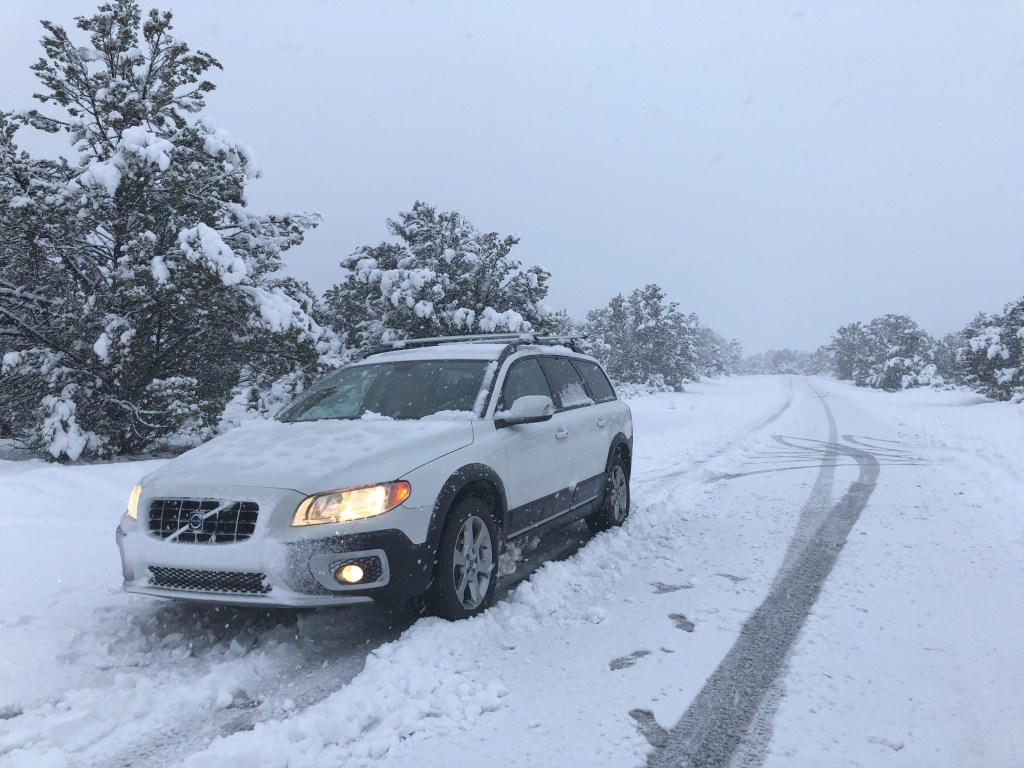
For our adventures, we bought a 2009 Volvo XC70 nearly five years ago. It was eight months into the pandemic when new vehicles were impossible to find. We knew that we wanted a vehicle with good ground clearance, all-wheel-drive, and generous cargo space. The Volvo checked all of those boxes, and the 18.5-gallon fuel tank offered an excellent range.
So, after some searching, I found our Volvo through a Facebook Marketplace listing. It was in Flagstaff, Arizona, and the previous owner was using it “like a pickup truck.” The vehicle had a couple of clear issues. His dog had chewed up the rear passenger seat bolster, as well as the seatbelt. Also, although he had been diligent on oil changes, the instrument cluster displayed “schedule maintenance” soon.
I really should have gotten the vehicle professionally inspected, but he was only asking $7,500 for it. It only had 80,000 miles on the odometer. Plus, I was smitten with the vehicle as soon as I showed up to look at it. We found a notary to sign over the title, I gave him his check, and we headed back to Phoenix.
I wanted to get all the fluids exchanged and have the seatbelt repaired, so an appointment was scheduled with the mechanic. Unfortunately, I also discovered that the auxiliary belts needed replacement, the motor mounts collapsed, and the rear brake booster needed a rebuild. The gauge cluster also began telling us that the hood was open, but it clearly wasn’t.
Over the next year, it also needed a new fuel rail, a new windshield washer reservoir, new struts, and a new oil trap for its’ 3.2 liter naturally aspirated six-cylinder engine. The total cost for all the repairs was nearly what we paid for the car itself (but still far less than a new vehicle).
Despite the unexpected costs, I don’t regret our decision to buy the old XC70. The boxy wagon is a relic of a past era in automobiles. It was built in Gothenburg, Sweden, when Volvo was still owned by Ford Motor Company. There are no touchscreens, no apps, and no subscriptions.
The sixteen-year-old interior has less rattles than our other vehicle (which is less than a year old). The soft suspension rides great on dirt roads and the Haldex all-wheel-drive system has kept us safe through multiple severe winter storms. It even has hill descent control.
For tires, I selected Continental TrueContact Tour tires. They prioritize tread life, road noise, handling in wet conditions, and light snow. They aren’t all-terrain tires, but we spend most of our time on paved surfaces anyways. A two-inch hitch was also added, along with a Thule Epos bicycle rack.
We drive it about six thousand miles per year, and our Arizona climate is exceptionally hot. Our owner’s manual says, “when temperatures exceed 104 degrees Fahrenheit in your area, Volvo recommends, for the protection of your engine, that you use a heavier weight oil such, as SAE 5W-40 or 0W-40. See the viscosity chart.”
I’ve heard that heavier weight oils can provide better lubrication once they are up to temperature, so I took Volvo up on that invitation. I’m currently running Motul 5W-40 Synthetic X-Cess Gen 2. I’ll probably exchange the oil for 5W-30 if we have any winter adventures planned.
An underrated feature of Volvos is that they seem to have higher roof rack capacities than most other manufacturers. Our manual shows a capacity of 220 lbs. For comparison, Ford rates the roof rack load capacity of a 2025 Ford Expedition without a glass roof at 200 lbs. Jeep only rates their 2025 Grand Cherokee or Wagoneer roof rack at 150 lbs.
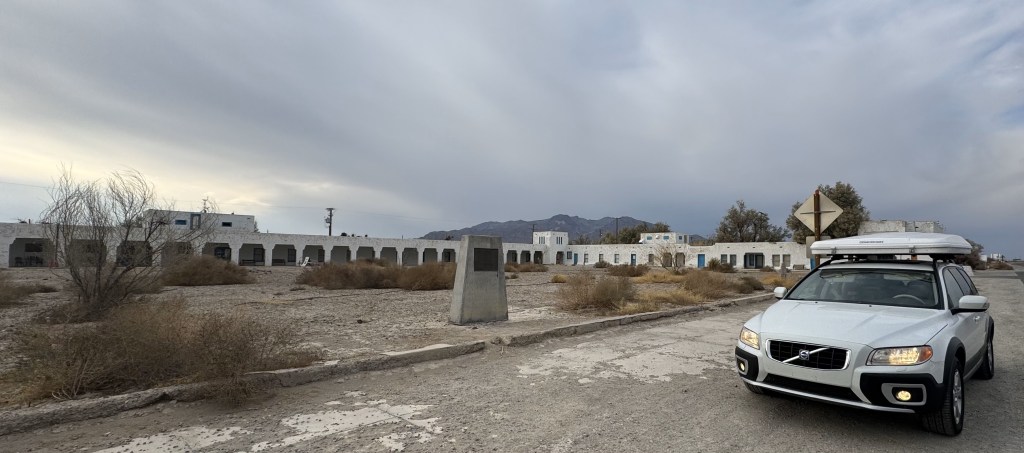
About two years ago, we also added an Autohome Maggiolina tent to the Volvo. The Maggiolina is a fiberglass hardshell tent which is made in Italy. Our model uses a hand crank, which turns a worm gear and raises the entire tent in about a minute. Best of all, the canvas construction is exceptionally quiet in windy conditions.
I’ll do a full write up about the tent in a future post, but it has allowed us to use our XC70 like a compact and fuel-efficient RV.
 Pistons Then Pedals
Leave a comment